By Jamie Roach
“Be a community of love.” That’s the clear vision that my wife, Lea Ann, and I have always held onto for our family. That no matter how hard life became outside our walls, there would be softness between ours. No matter how fast the pace became out there, we would slow down in here. No matter how dangerous it felt at school, we wanted our home to feel safe. When our kids felt left out of their friend group, we wanted them to know they belonged at home. With each additional child, this vision became both more important and increasingly difficult to hold on to.
As we enter another school year, what is the vision or hope you have for your family? Is it enough to be a group of busy and maybe even successful individuals, or are you hoping for more?
We discovered that when it comes to being a family, doing less is more. And doing it slower is a faster way to arrive. It also takes courage when the voices around you are screaming to keep up. This is where having a clear calling from God about what you want your family to be can be so helpful. It serves as an anchor when the winds of popular culture are blowing strong and the waves of social pressure are rising.
Writer and theologian Henri Nouwen wrote something that has followed me around for years: “Discipline means to prevent everything in your life from being filled up.” Not control. Not white-knuckling. Just the ordinary work of keeping some space open so that something can happen you hadn’t planned on.
By that definition, most of us are not undisciplined in August. We are overcommitted, which is a different problem. And it doesn’t feel like sin. It feels like love. That’s what makes it so hard to see.
The script nobody handed you
Christian scholar Walter Brueggemann says everybody lives by a script, and that we get scripted without ever knowing it happened. Our family calendar was a script. It was never written down or voted on. It accumulated, one reasonable yes at a time, until it was teaching our kids something we never chose to teach them.
Jesus’ invitation in Matthew 11 has always struck me as strangely unhurried: “Are you tired? Worn out?… Come to me. Get away with me and you’ll recover your life… Learn the unforced rhythms of grace” (Matt. 11:28-30 MSG).
The life Jesus offered is not optimized nor efficient; it is unforced and must be received.
And have you noticed how Jesus moves through the Gospels? He walks everywhere. He gets interrupted constantly — and the interruptions keep turning out to be the point.
This is what I keep having to relearn: love is inefficient. Listening takes longer than instructing. Presence can’t be booked in fifteen-minute increments. A community of love runs on what looks, from the outside, like wasted time — the long dinner, the slow bedtime, the drive with no destination.
You can’t build a home like that on a full calendar. There’s nowhere to put it.
Psychiatrist Dan Siegel’s work on co-regulation says what we already know in our bodies: a child who can’t yet regulate borrows the nervous system of the nearest calm adult. Pace is caught the same way.
So the real risk of a full schedule isn’t exhaustion; exhaustion passes. The risk is that our kids are formed in an identity of performance rather than belovedness — that they come to believe, without anyone ever saying it, that a full calendar is the evidence of a life that matters.
Three questions before the next yes
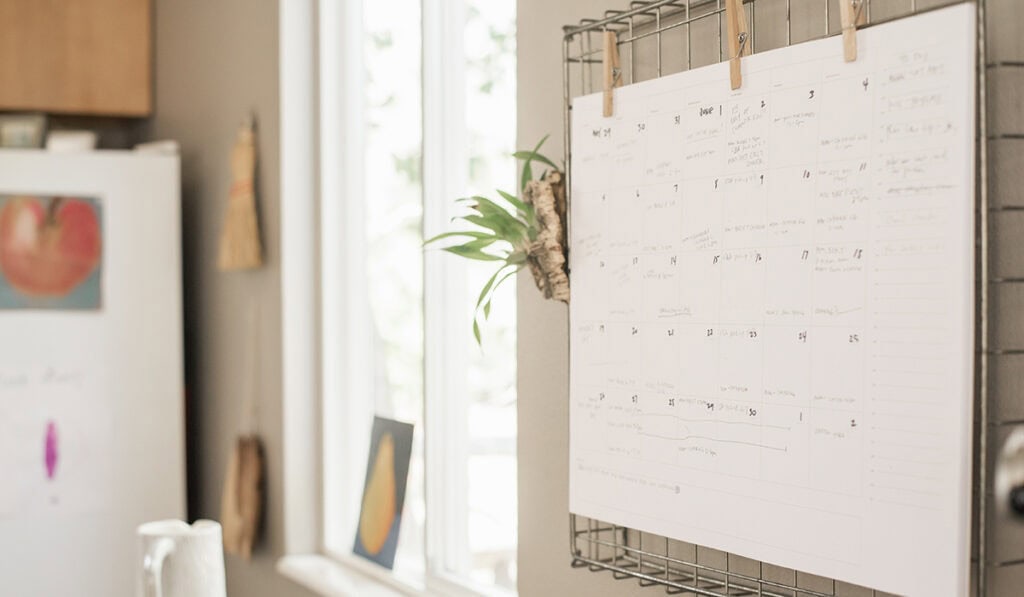
Consider filtering possible commitments through these three questions before giving a “yes” this fall. Note that this is not meant to be a rigid system. Just three questions to sit with before filling in another square.
- Who am I afraid of disappointing by saying “no”? If a primary motivation for my saying “yes” is the fear of disappointing someone else (another parent, teacher, etc.), perhaps I should rethink my yes.
- What is this “yes” replacing? Every yes is a no to something already there. Usually the unscheduled things — dinner, bedtime, margin — because they have no one defending them.
- Is my child asking for this, or am I? Sometimes the honest answer is that I want it for them. That’s worth knowing before I sign them up.
And one practice: leave a square empty on purpose. One evening a week with nothing in it. Defend it the way you’d defend a championship game. It is here, where the unplanned things happen — the conversation no one forgets, the kid who finally talks, the evening everyone will be talking about for years to come.
Back to the vision
So I’ll ask again: what do you want your family to be?
If the answer is a community of love, then some of what’s being offered to you this fall isn’t for you. Not because it’s bad. But because it doesn’t fit what you’re wanting.
You won’t always get this right. We haven’t in our family. The fall will fill up anyway, and some of what fills it will be genuinely good. But you are not what you can squeeze into your calendar. Your children are not what they accomplish. Before anything is scheduled, you are already the beloved.
Leave a square empty. See what God does with it.
About Jamie Roach: Jamie has served on the staff of Youthfront for 35 years, working with students, parents and youth workers. His passion is seeing people live their best life. Jamie is a spiritual director, author, communicator and Licensed Professional Counselor at Youthfront’s affiliate, Presence-Centered Counseling. He received his Master of Divinity degree from Nazarene Theological Seminary and a Master of Arts in Counseling from Mid-America Nazarene University. Jamie loves Nebraska football, reading, walks in the woods and hanging out with his family. Jamie and his wife Lea Ann have four adult children and four grandchildren.